Moray and the Maras Salt Ponds
A half day into the Sacred Valley’s high plain: Moray’s concentric rings run measurable temperature differences — the laboratory reading told as a reading — and Maras’ three thousand salt ponds still feed a community economy.
The short version
- The ticketing per the alarm splits: Moray sits on the boleto turístico (the partial circuit covering the Sacred Valley sites works for this day), while the Maras salt pans are community-operated with their own modest cash fee at the gate — small bills the standing courtesy.
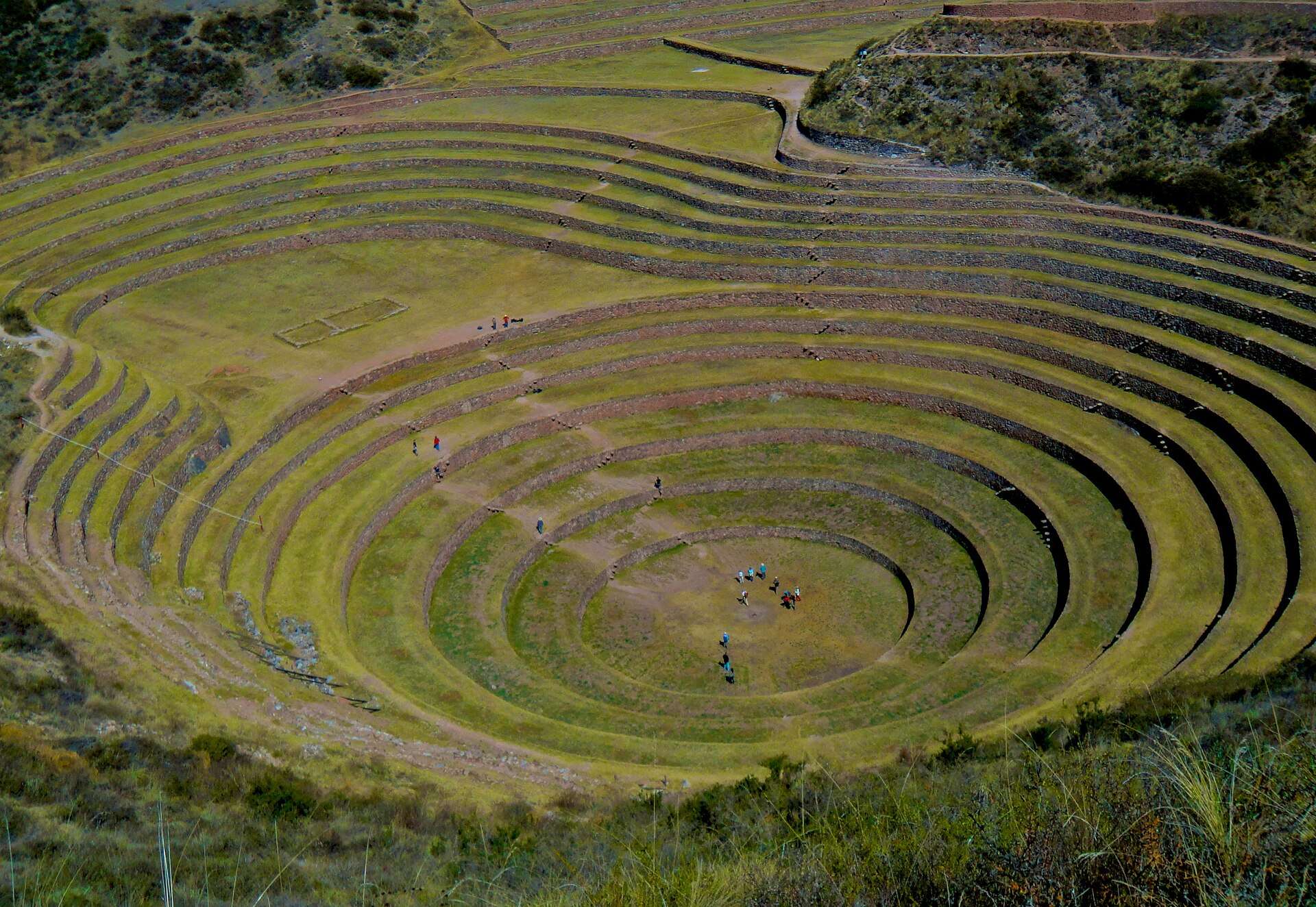
- Moray’s concentric terraced bowls — the largest dropping some 30 stories of rings into the earth — hold measured temperature differences of several degrees between top and bottom; the leading interpretation reads an Inca agricultural research station testing crops across microclimates, and the site’s own framing per the alarm presents it as the leading reading rather than settled fact.
- The Salineras de Maras run roughly 3,000+ shallow evaporation ponds down a salty spring’s hillside — worked since pre-Inca times, farmed today by local families whose plots pass through generations, with the harvest’s whites and pinks terracing the canyon.
- The access fact: visitors walk the rim paths and overlooks these days — the once-standard stroll among the working ponds ended years ago for the ponds’ protection — and the viewing terraces frame the full amphitheater regardless.
- The salt at the gate per the alarm carries real provenance: the families’ harvest sold in grades from cooking coarse to flor de sal, priced modestly at the source and funding the system that produces it.
- The half-day logistics run flexible: tours bundle both sites from Cusco, taxis negotiate the loop, and colectivo-plus-local-taxi does it at backpacker prices — with the pairing folding naturally into this network’s fuller Sacred Valley day for those building the bigger circuit, and the altitude (3,300m+) applying its standing rules.

Getting there
The loop drives the high plain above the Urubamba: Cusco over the Chinchero plateau, Moray’s turnoff through Maras village’s colonial doorways, and the salt-pan canyon beyond — ninety minutes of altiplano views that are half the excursion. Tours handle it turnkey; the taxi-negotiated version buys unhurried overlook time. The alarm’s two-currency reality (boleto for Moray, cash for Maras) plus water and sun protection at altitude complete the kit. Morning departures beat both the light-flattening haze and the tour-bus stack.
The visit
Moray first: the main bowl from the upper rim — the rings’ geometry reading as pure land art before any interpretation lands — then the perimeter path’s angles on the restored terracing and the smaller adjacent bowls. The laboratory reading per the alarm gets its plain telling: the temperature gradients are measured fact, the crop-testing purpose is the strong inference the signage and guides present as such, and the mystery remaining is part of the site’s pull. Maras follows down the canyon: the first full view of the pans is the day’s photograph — thousands of white-and-ochre trays stepping toward the valley — and the rim paths work the scene from above while the families work the water below: channeling the spring, raking crystallizing salt, sacking the harvest. The gate stalls close the loop per the alarm: salt by the kilo with the provenance visible behind it. The return runs Chinchero’s weaving cooperatives or straight over the plateau; either way the half day lands you back in Cusco with the afternoon intact.
When to go
April through October’s dry season runs the reliable version — clear altiplano light, active salt harvest (the dry months concentrate production, whitening the pans to their brightest), and firm paths. November through March greens the plateau spectacularly and browns the pans’ palette with rainwater dilution; visits still work between showers. Year-round, mornings serve photographers and altitude-cautious walkers alike per the alarm’s slow-walking rule — and travelers fresh off the plane give Cusco a day or two first, per this network’s standing acclimatization arithmetic.
Frequently Asked Questions
Is the laboratory theory actually true?
It’s the leading scholarly reading, presented per the alarm as a reading: the temperature differentials are measured, the terrace soils show imported earth, and the crop-experimentation interpretation fits — but Inca sources are silent and alternatives (ceremonial functions among them) stay live. The site’s honesty about its own mystery is part of what it teaches.
Why can’t you walk among the salt ponds anymore?
Volume — visitor traffic on the narrow mud walls damaged working ponds and contaminated harvests, and the community closed the pond-level paths years ago in favor of rim viewing. The overlooks frame the amphitheater better than the old ground-level scramble did, and the working families’ livelihood outranks the selfie angle.
Boleto turístico: which version do I need?
The partial circuit covering the Sacred Valley sites (Moray among them) suffices for this day and prices below the full ticket; the full boleto makes sense only when Cusco’s city sites and the wider valley are all on your list. Maras’ community fee stays separate and cash regardless — the alarm’s small-bills clause.
Can I combine this with the wider Sacred Valley?
Naturally — Moray and Maras slot into this network’s Sacred Valley day (documented separately) as its high-plain leg, and full-valley tours stack them with Pisac or Ollantaytambo. The standalone half-day version this page runs exists for travelers pacing themselves at altitude, which the alarm’s 3,300-meter clause endorses.
Is the salt actually worth buying?
As provenance souvenirs go, it’s among travel’s best: harvested meters away by the families selling it, graded honestly, priced in small bills, and light in the luggage. The flor de sal grade gifts well. It’s also simply good salt — the pink mineral tint is the spring’s chemistry, not marketing.